










Limousine pricing sounds straightforward until you compare two quotes that look similar on the surface—but land far apart in the total. The gap is usually not “random markup.” It’s the assumptions: minimums, how waiting is counted, how stops behave, and how messy the pickup actually is in real life.
Here’s a clean way to understand pricing, read a quote without surprises, and request numbers that stay accurate on trip day.
Table of Contents
🚦 Quick takeaway (the 60-second version)
Most quotes are built from four levers:
- Vehicle class + capacity (what you reserve)
- Time window + minimums (when and how long the vehicle is committed)
- Stops + waiting rules (how the trip behaves once it starts)
- Peak demand (weekends, late nights, big events)
If you want to compare options without guessing what’s “included,” start here: Limousine Service Pricing.
Pricing models: which one applies to your trip
Not every trip should be priced the same way. A mismatch is how people overpay.
Hourly service
Hourly works best when the plan can drift: multiple stops, photos, event flow, “we’ll be ready soon,” or meetings that run long.
What changes the total:
- minimum hours (especially evenings/weekends)
- overtime increments (how billing rounds)
- what starts the clock (arrival vs dispatch policy varies)
Point-to-point (flat rate)
Flat rate is best when it’s truly one pickup → one drop-off and timing is stable.
What matters:
- stop rules (a “quick stop” can flip the quote)
- route changes (detours can trigger re-pricing)
- whether any waiting is included
Event packages (weddings, proms, nights out)
Packages can be excellent when you want predictable costs.
What to confirm:
- what’s actually included (every package is different)
- late-night rules
- cleaning policies (what triggers fees)
The real price drivers (the checklist that changes the quote)
Mileage is rarely the main story. These are.
1) Vehicle class & capacity
Bigger is more than “more seats.” It usually means different availability, different minimums, and more staging time. A common pricing jump happens when you move from “fits people” to “fits people + luggage comfortably.”
2) Date & time
Peak windows raise pricing because supply gets tight:
- Friday/Saturday evenings
- event nights
- late-night returns
- early-morning airport departures
3) Duration vs distance (why short trips can still cost more)
A 10–15 minute ride can still hit a 2–4 hour minimum during peak time because you’re reserving the vehicle and driver—not just buying miles.
4) Stops and route changes
Stops add more than distance:
- load/unload time
- curb access uncertainty
- extra looping when the curb is controlled
Two “quick” stops can be what turns a clean flat rate into an hourly situation.

5) Wait time rules (where quotes diverge)
Waiting is the biggest hidden difference between quotes.
- At airports, baggage delays and curb control can turn “5 minutes” into 25.
- At venues, a crowded exit can force the vehicle to loop instead of holding at the curb.
6) Tolls, parking, terminal/venue access fees
Some companies include them, some itemize them, and some bill actuals later. The quote should make that obvious.
7) Service charge vs gratuity
Many clients assume they’re the same line item. They aren’t always. A clean quote clearly separates:
- base rate
- any service/administrative charge
- gratuity (included or not)
- taxes/fees (if applicable)
Ready to lock in a clean, no-surprises quote?
Request your Limousine Service Pricing breakdown and share your date, pickup/drop-off, passenger count, stops, and flight details (if any). We’ll reply with a clear line-by-line estimate and the best vehicle match.
Fleet tiers: pick the right ride for the budget (without under-sizing)

Saving money isn’t “pick the cheapest vehicle.” It’s “pick the vehicle that won’t create overtime or a second trip.”
Luxury sedan
Best for: solo travelers, couples, business trips, light luggage.
Premium SUV
Best for: families, airport luggage, extra comfort, small groups that need space.
Stretch limousine
Best for: celebrations, photo moments, formal arrivals, “everyone together.”
Sprinter / party bus
Best for: coordinated groups, multiple pickups, event flow (but stops + waiting are the big cost lever).
Real-world scenarios: what a quote is really assuming
This is where pricing becomes real.
Airport transfer (simple on paper, tricky at the curb)
Airport pickups can be calm or chaotic depending on timing. A few “tiny” realities that change cost:
- arrivals curb can be controlled, forcing a loop instead of a clean pull-up
- groups move slower than expected (restrooms, baggage, last-minute calls)
- meeting details matter: airline + door/column area is faster than “we’re outside”
If you’re comparing airport options and timing realities, use Seattle Airport Transportation to map out pickup patterns and reduce paid waiting surprises.

Corporate schedule (multiple stops, tight timing)
Price rises when the itinerary needs buffers: security check-ins, elevator delays, meeting overrun, last-minute address changes. A quote is only “accurate” if it matches how the day actually behaves.
Wedding day (ceremony + photos + reception)
Totals are driven by idle time between segments and photo stops that look quick but aren’t. The best wedding quotes spell out what “included time” means between events.
Prom / night out (late-night risk)
The biggest swing is the pickup window. Crowds + curb closures + shifting meetup plans can turn into paid waiting fast—unless the meetup is defined like a script.
How to read a limousine quote (line by line)
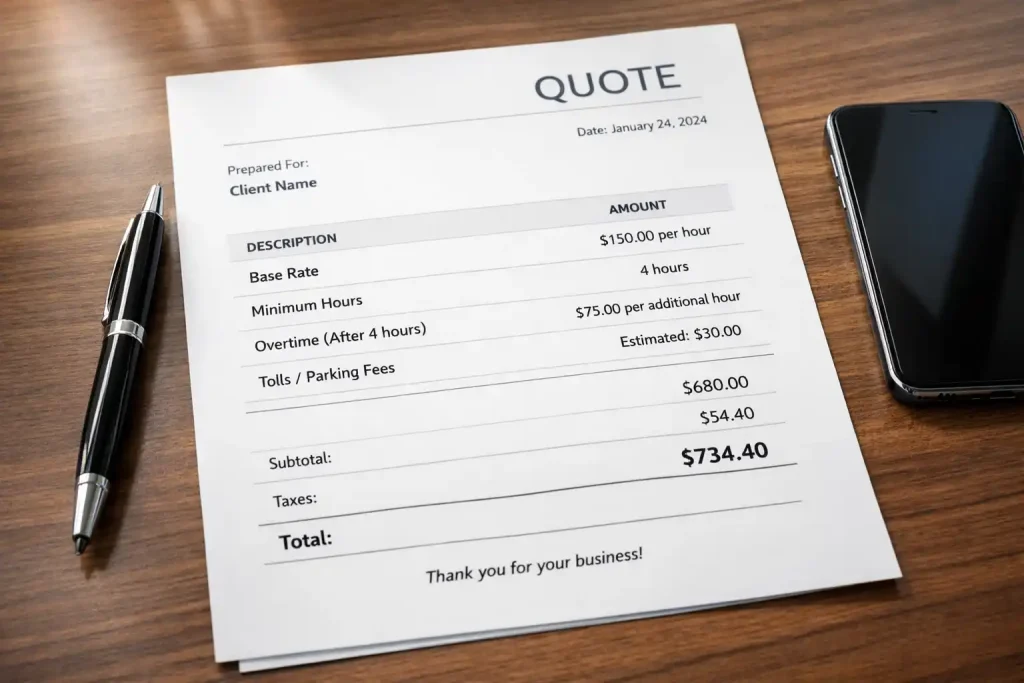
Before comparing totals, compare assumptions.
Minimum hours
This is the base of everything. Two quotes can differ mainly because one assumes a longer minimum.
Overtime math
Look for:
- billing increments (15/30/60)
- rounding rules
- when overtime starts (after minimum vs after scheduled end)
Wait time policy
This should be explicit:
- grace period (if any)
- what counts as waiting
- exceptions (airport/controlled access policies)
Changes and cancellations
A “cheap” quote can get expensive if normal changes trigger penalties: time shifts, adding a stop, pickup adjustment.
Cleaning/damage rules
Most professional operators are fair here—just make sure it’s written clearly.
How to lower the price without lowering quality
- Match vehicle size to real headcount + luggage
- Consolidate stops (avoid micro-stops that inflate time)
- Choose off-peak windows when you can
- Use a clear meetup plan (less paid waiting)
- Add realistic buffers (planned time beats chaotic overtime)
Red flags: when “cheap pricing” becomes expensive
- vague “fees later”
- no overtime or wait-time rules in writing
- unclear minimums
- no process for controlled curb access
- no confirmation checklist (they’re guessing your trip)
What to send for an accurate quote
✅ Date + pickup time window
✅ Pickup + drop-off addresses
✅ Passenger count + luggage estimate
✅ Stops (and how long at each)
✅ Vehicle preference (or “best fit”)
✅ Flight details (if airport)
✅ Any special needs (child seat, meet & greet, extra trunk space)
FAQ
Is gratuity already included in the quote, or is it added later?
Usually it’s one of three setups: gratuity included, gratuity not included and added separately, or a quote shows a service/administrative fee while gratuity remains separate. A clean quote states it plainly (“Gratuity included: yes/no” + % or amount). If it’s not stated, assume it’s not included and confirm before booking.
What’s the minimum booking time for this date/time, and why?
Minimums are most common during peak demand because the vehicle is reserved in a block and can’t easily be slotted between other trips. Weekday daytime minimums are often lower; Friday/Saturday nights are often higher. For short rides, the minimum isn’t “extra miles”—it’s the cost of reserving that vehicle and driver for your time window.
How exactly is overtime billed—by 15 minutes, 30 minutes, or a full hour?
Overtime is typically billed in increments (15/30/60 minutes) and almost always rounded up to the next increment. The key detail is when overtime starts: after the included time, or after the scheduled end time. Ask for it in writing: “Overtime billed in ___-minute increments, rounded up, starting after ___.”
If we add 1–2 quick stops, does it add a fee or does it convert to hourly?
Most companies do it one of two ways: a per-stop add-on (if the stop is truly short and pre-approved) or a switch to hourly if stops introduce wait risk and schedule drift. “Quick stop” often means 5–10 minutes with no parking loops, lines, or extended waiting. Best practice: list each stop in advance and estimate the time at each one.
What parts of the quote are included, and what’s itemized (tolls, parking, access fees)?
“Included” is usually vehicle + chauffeur + base time/route. Common itemized (or pass-through) costs are tolls, parking, airport/venue access fees, and sometimes a service/dispatch fee. Ask for a simple breakdown: “Base + gratuity/service + estimated tolls/parking + any airport/venue fees,” so you can compare quotes apples-to-apples.
Wrap-up
Limousine service isn’t priced like a taxi ride—it’s priced like a reserved asset with rules around time, access, and availability. Once you understand minimums, waiting, stops, and peak windows, comparing quotes becomes simple—and your final cost becomes predictable.